
The Neural Underpinnings of Childhood Adversity (NUCA)
Childhood adversity is associated with increased risk for later mental health problems, but the pathways linking early experiences to the adult brain remain incompletely understood (Kessler et al., 2010). These associations are difficult to study because they are likely to be small, distributed across brain systems, and shaped by many years of intervening experiences.
In NUCA, we examined whether five types of childhood adversity (emotional abuse, emotional neglect, physical abuse, physical neglect and sexual abuse) were associated with resting-state functional connectivity in later life. Resting-state functional connectivity describes how activity across large-scale brain networks is coordinated while a person is not performing a specific task.
We used UK Biobank imaging-derived measures from 62,246 participants and examined 210 connections between brain networks (Miller et al., 2016; Alfaro-Almagro et al., 2018). To prioritise robust findings, associations had to be consistent across two assessments of childhood adversity collected seven years apart. We then tested them in a separate imaging sample and examined whether they remained after adjustment for current depression and anxiety symptoms (sensitivity analyses – Figure 1).
We identified 53 adversity–connectivity associations that were consistent across both adversity assessments. Most involved emotional abuse and emotional neglect and were distributed across several networks, including default mode, visual, motor, fronto-parietal, salience and subcortical systems. Three associations replicated in the second imaging sample. After adjustment for depression and anxiety symptoms, 17 remained, with the association between emotional neglect and left fronto-parietal–default mode connectivity showing the most consistent evidence.
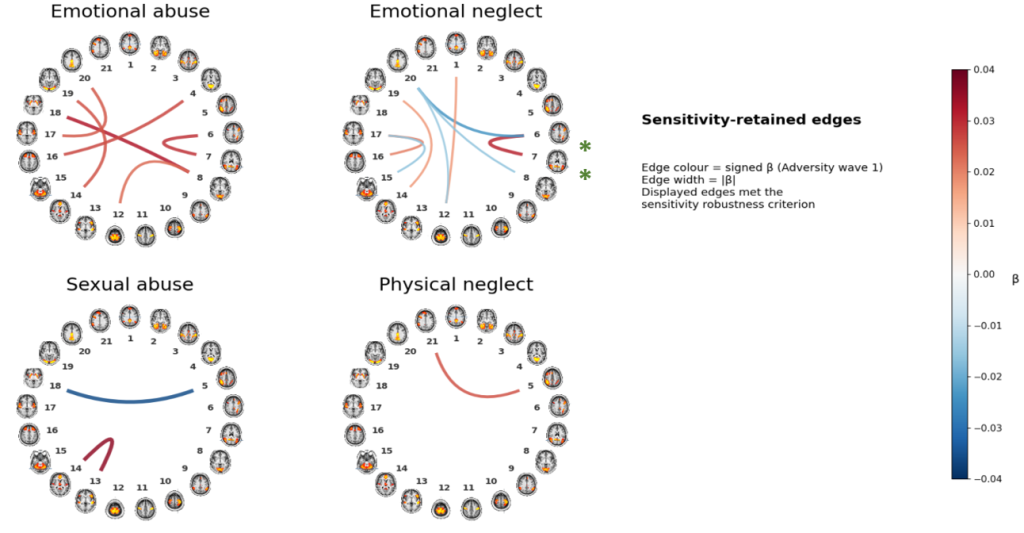
These findings suggest that associations between retrospectively reported childhood adversity and later-life brain connectivity can be detected at the population level. However, the effects were small, and only a limited number remained consistent across assessments and samples. Rather than identifying every possible association, we prioritised robustness and reproducibility.
Not everyone exposed to adversity develops the same mental health or neurobiological outcomes. We therefore also calculated a polygenic risk score for neuroticism, a trait associated with stress sensitivity and negative emotionality, using independent Genetics of Personality Consortium data (de Moor et al., 2015). This choice was informed by related NUCA work showing that neuroticism may be an important pathway linking adversity with later mental health and cognition (Künzi et al., 2026). The score showed the expected small positive association with measured neuroticism, and preliminary analyses examined whether genetic susceptibility moderated adversity–connectivity associations.
The imaging and genetic analyses are being integrated into the main NUCA manuscript.
References
Alfaro-Almagro, F., et al. (2018). Image processing and quality control for the first 10,000 brain imaging datasets from UK Biobank. NeuroImage, 166, 400–424.
de Moor, M. H. M., et al. (2015). Meta-analysis of genome-wide association studies for neuroticism, and the polygenic association with major depressive disorder. JAMA Psychiatry, 72(7), 642–650.
Gheorghe, D. A., Shahabuddin, A., Künzi, M., & Bauermeister, S. (in preparation). Childhood adversity and resting-state functional connectivity: A cross-sectional discovery and replication study in the UK Biobank.
Kessler, R. C., et al. (2010). Childhood adversities and adult psychopathology in the WHO World Mental Health Surveys. The British Journal of Psychiatry, 197(5), 378–385.
Künzi, M., Gheorghe, D. A., Lian, J., & Bauermeister, S. (2026). Associations between early-life adversity, coping strategies, and adult mental health, brain, and cognition. Scientific Reports, 16, 12147.
Miller, K. L., et al. (2016). Multimodal population brain imaging in the UK Biobank prospective epidemiological study. Nature Neuroscience, 19, 1523–1536.
The work is supported by a research fellowship awarded by the European Research Executive Agency through the HORIZON-WIDERA-2022-TALENTS-02 programme (project number: 101090316, NUCA).